Field Note No. 3 The Addiction to Being Needed New Blog Post
Field Note No. 3
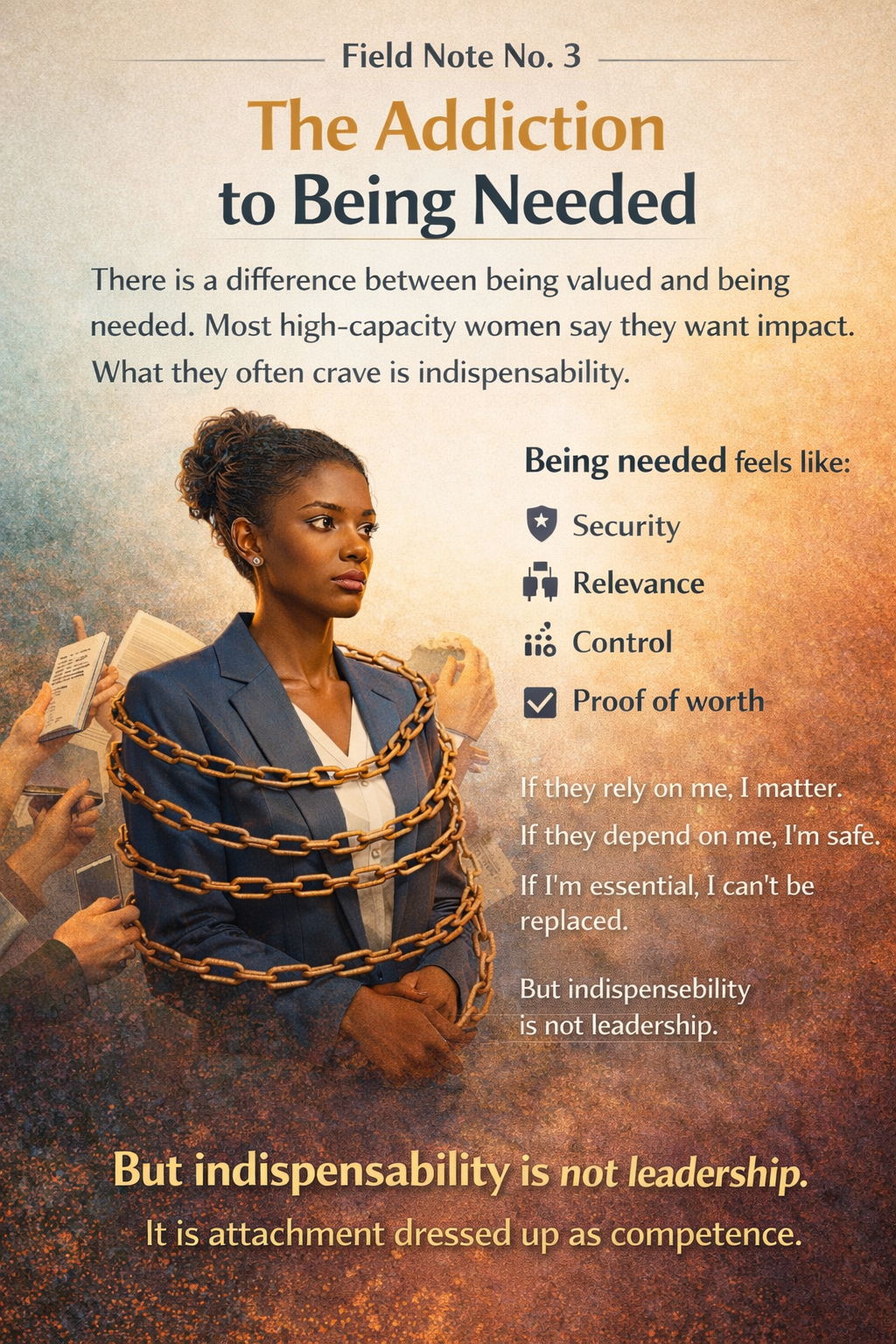
The Addiction to Being Needed
There is a difference between being valued and being needed.
Most high-capacity women say they want impact.
What they often crave is indispensability.
Being needed feels like:
Security
Relevance
Control
Proof of worth
If they rely on me, I matter.
If they depend on me, I’m safe.
If I’m essential, I can’t be replaced.
But indispensability is not leadership.
It is attachment dressed up as competence.
The Mirror
A few years ago, my husband started handling things I normally controlled.
Finances.
Logistics.
Decisions I used to preemptively own.
He didn’t ask.
He didn’t challenge me.
He just stepped in.
And I felt it immediately.
Not anger.
Not even irritation.
A spike.
A flash of irrelevance.
My body registered threat before my mind had language for it.
I told myself it was about standards.
Efficiency.
Preference.
It wasn’t.
It was the loss of centrality.
If he could operate without me…
what exactly was my role?
That question exposed something I didn’t want to see.
I didn’t just like being valued.
I needed to be needed.
How the Pattern Actually Works
It rarely looks unhealthy.
It looks like:
You answer before they struggle.
You fix before they fail.
You anticipate before they ask.
You hold institutional memory.
You become the emotional regulator in every room.
You call it excellence.
What it really is: preemptive control.
You remove friction so you don’t have to tolerate uncertainty.
You overfunction so you don’t have to feel disposable.
You stay central so you don’t have to confront irrelevance.
And everyone praises you for it.
Until:
You’re exhausted.
You resent the very people you “support.”
You panic when someone succeeds without you.
That panic is the tell.
The Origin (Not the Buzzword Version)
This didn’t start in a boardroom.
It started when usefulness equaled safety.
You were:
The responsible one.
The mediator.
The emotionally attuned one.
The one who didn’t need much.
Love was conditional on contribution.
So your nervous system made a contract:
If I am useful, I stay connected.
If I am indispensable, I cannot be abandoned.
That wiring doesn’t disappear when you get promoted.
It scales.
The Cost to Leadership
An insecure ego wants to be admired.
An anxious attachment wants to be needed.
When you build identity around being needed:
Delegation feels threatening.
Autonomy in others feels destabilizing.
Partnership feels like competition.
Rest feels like risk.
You say you want empowered teams.
But unconsciously, you tighten when they stop consulting you.
A team cannot outgrow a leader who needs to remain central.
A partner cannot expand under someone who equates independence with loss.
Dependency is not loyalty.
It is delayed dysfunction.
The Shift: From Needed to Chosen
The turning point isn’t when people rely on you.
It’s when they don’t — and you’re still steady.
When my husband began handling things without me, I felt the spike.
Not anger.
Not even jealousy.
Irrelevance.
And beneath it — relief.
If he could lead himself, I didn’t lose value.
I lost control.
And control was never the same thing as connection.
Being chosen is different than being needed.
Chosen says:
“I can function without you — and I still want you here.”
Needed says:
“I struggle without you — don’t leave.”
Only one of those builds sovereignty.
Practical Audit (No Escaping Here)
If you want to know whether this pattern runs you, answer honestly:
Do you feel uneasy when someone executes well without your input?
Do you subtly redo work that was already done competently?
Do you struggle to rest unless everything routes through you?
Do you confuse being the stabilizer with being the leader?
Do you feel most valuable when others are slightly dependent?
If yes, this isn’t ambition.
It’s attachment.
What Secure Leadership Looks Like
Secure leaders:
Build systems that function without them.
Celebrate when they’re no longer the bottleneck.
Tolerate being unnecessary in moments.
Separate identity from utility.
You are not powerful because they cannot function without you.
You are powerful when they can — and they still choose to collaborate.
Closing
Being needed is loud.
It feeds the ego quickly.
Being secure is quiet.
It builds legacy slowly.
The real question isn’t:
“Do they rely on me?”
It’s:
“Who am I if they don’t?”
If that question makes you tense, you’ve found your work.